

FURNITURE & MOVING / FROM THE BLOG
Making Room for Under-Bed Drawers
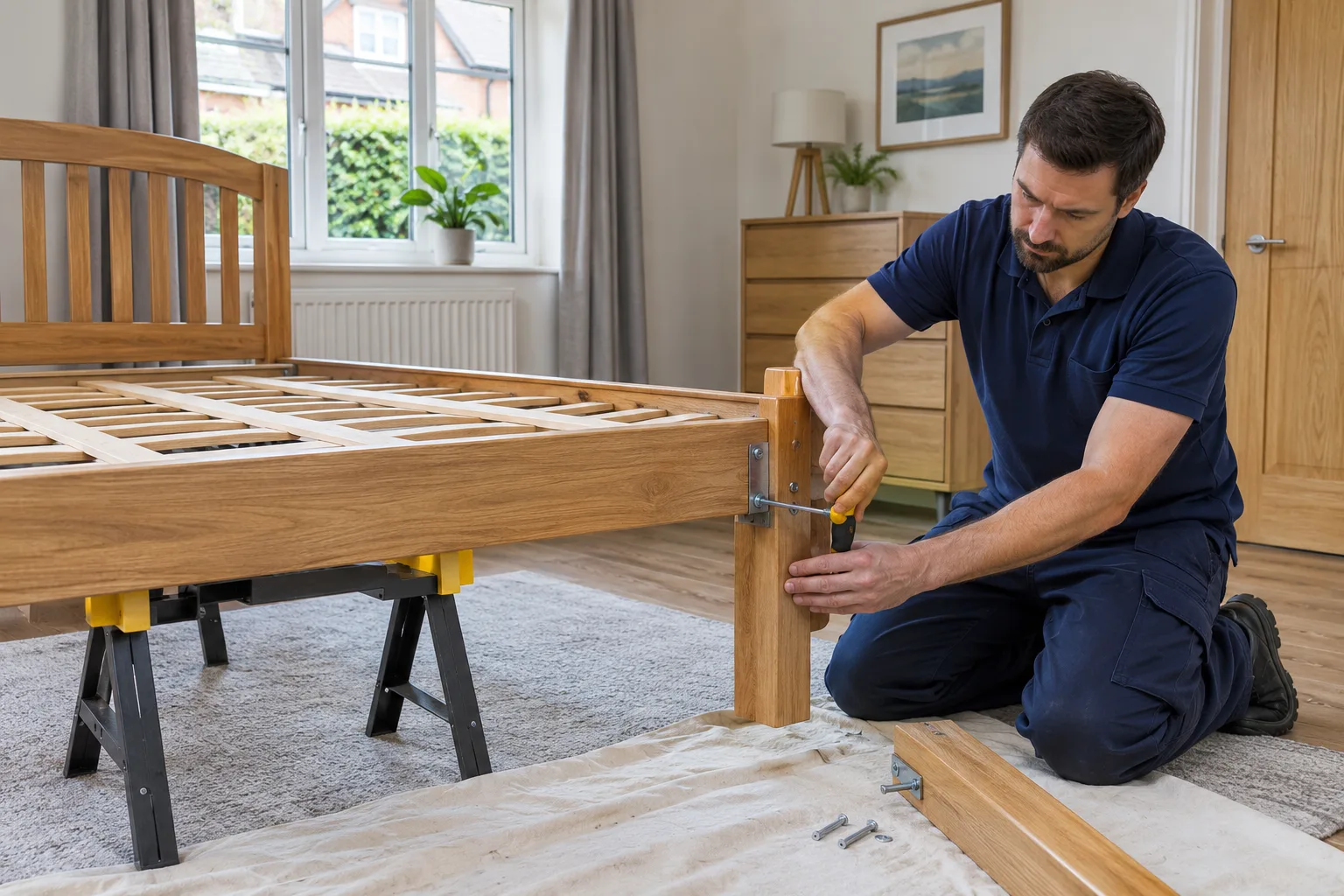
A drawer bed can appear to fit a bedroom perfectly until the first drawer is pulled out. The mattress and frame may clear the walls, yet the drawer front hits a bedside table, radiator or skirting board before it reaches its usable opening. That is awkward to correct once a heavy bed has been assembled and dressed. Before choosing its position, measure the whole movement of each drawer, including space for a person to stand beside it and lift stored items out.
Start with the manufacturer’s drawing for the exact bed size and storage version. Similar looking frames can have different drawer depths, runner extensions and pull-out directions. Check whether storage is fitted on one side, both sides or at the foot. A product photograph often shows a bed in an unusually wide room; it does not tell you how far the drawer actually travels. Record the frame’s overall width and length, the projection of its headboard and the maximum extension of each drawer separately.
Measure the drawer in its open position
Place masking tape on the floor to outline the intended bed position. Mark the outside of the frame, not just the mattress edge. If the manufacturer’s dimensions include handles that protrude beyond the frame, include those too. From each drawer front, measure the stated pull-out distance into the room and add a small working allowance. That second allowance is for fingers on the handle and for reaching into the rear of the drawer. A drawer that opens to its limit against the edge of a bedside table may still be difficult to use.
Use a rigid tape measure or a piece of card cut to the projection of the drawer. Move it along the path at the height of the drawer front. Floor tape alone can miss a radiator valve, low shelf or wall-mounted fitting that projects into the moving front’s path. Check both the front and the sides of the drawer as it opens. Some large storage drawers are wider than expected, so an angled bedside cabinet can obstruct a corner even when the centre line looks clear.
If dimensions are not supplied, ask the retailer or check the exact assembly manual rather than guessing from a photo. Do not assume the drawer will stop at half the depth of the bed. Full-extension runners, partial-extension runners and simple wheeled drawers behave differently. If the bed is already delivered, compare the longest drawer panel and runner length with the room before starting the frame build, while remembering that panel length is not itself a reliable measure of the final travel.
Check everyday furniture, not an empty floor
A bedroom is usually photographed with the bedside table tucked close to the mattress. Drawers may require it to move outwards, which can block a wardrobe or narrow the route to the door. Mark the positions of both bedside tables, a chest of drawers, a dressing table and the chair as they will normally stand. Open their doors or drawers too. Two pieces of furniture do not need to operate simultaneously every day, but one should not permanently trap access to the other.
Check the route a person takes around the bed. A drawer may clear a wardrobe door but leave no place to stand while lifting bedding out. If one side of the bed is against a wall, decide whether the drawers on that side can be omitted or whether the model is supplied with a specific single-side arrangement. Do not build unusable drawers simply because the kit contains parts for both sides. Follow the manufacturer’s permitted layout; a storage bay may contribute to the frame’s support.
At the foot, a drawer can conflict with the bedroom door or a narrow passage to a window. Test the door at its full swing rather than measuring only the closed opening. A foot drawer may also need more clearance than a side drawer because a person must stand beyond its open front. The room may accommodate the frame but not allow comfortable access to the storage it offers.
Account for skirting, radiators and uneven walls
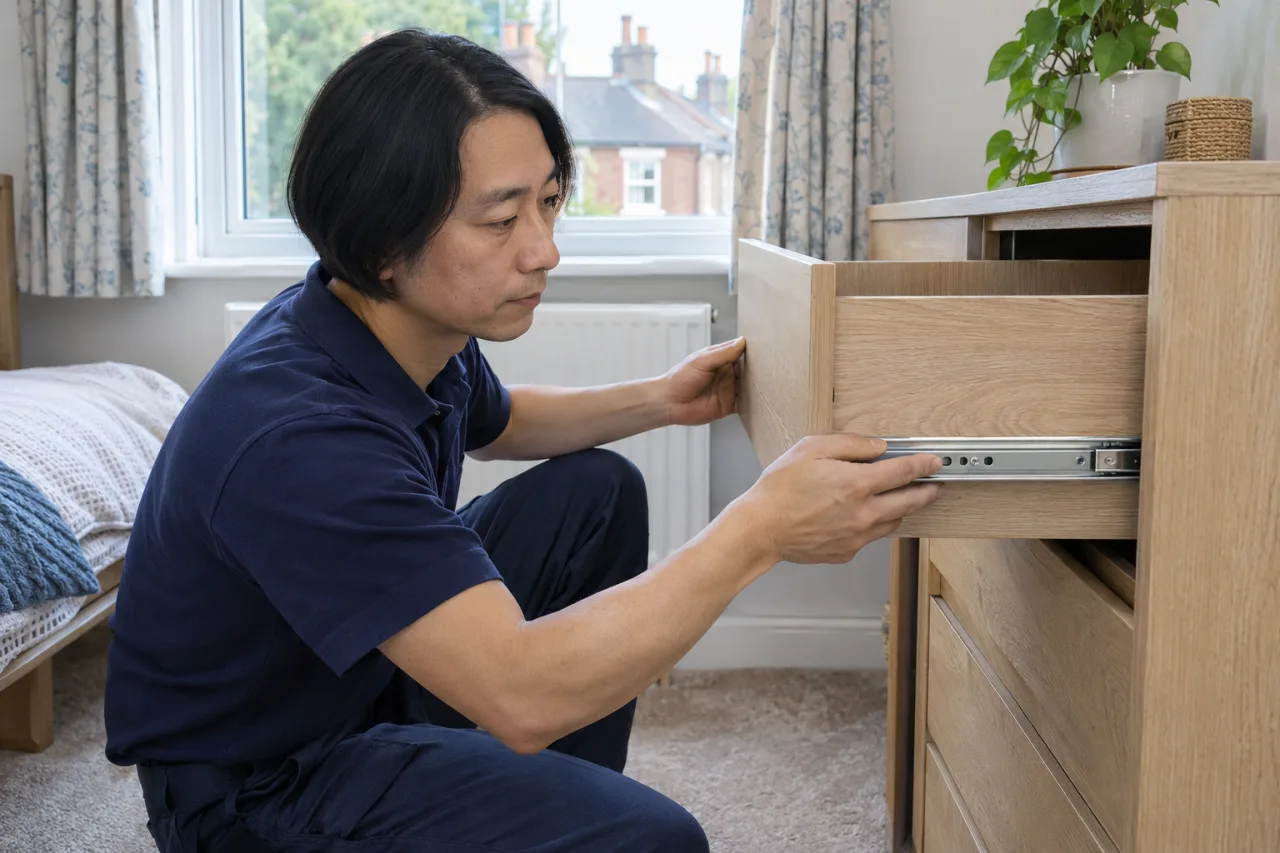
The frame may not sit flush against a wall because the skirting board projects at floor level. A thick skirting profile can shift the bed forward, changing the clearance at the foot. In a tight room, measure from the actual face of the skirting, not from the plaster above it. If the headboard is designed to stand against the wall, check whether it has an inset for skirting or needs a gap. Avoid forcing the bed against a moulding and twisting the frame.
A radiator on the storage side creates two questions. First, will the drawer physically pass its body, pipework and valves? Second, is the bed positioned in accordance with the radiator and furniture manufacturer’s advice about heat and airflow? A drawer filled with textiles should not be pressed against a heat source. Measure the radiator with its valves and covers, and leave access for maintenance. The same care applies to sockets and extension leads concealed behind a headboard.
Older rooms can have walls that are not parallel and floors that fall slightly. Measure at several points, including near the floor where a drawer runs. A gap that is generous at the headboard may narrow at the foot. If a rug sits beside the bed, consider its thickness and raised edge. A wheeled drawer may catch a rug, while a runner-mounted drawer can look crooked if the bed frame itself is pulled out of square by uneven support.
Understand the drawer mechanism
Storage drawers are not all part of the bed in the same way. Some run on metal slides fixed to the frame. Others roll independently on the floor. Some occupy an open recess and others have a front that closes flush with the side rail. Read the assembly sequence for the exact design. It may be necessary to fit runners before joining the bed sides, or to square the frame before inserting the drawers. The flat pack assembly service is relevant when the bed model, room measurements and storage configuration are provided in advance.
For runner-mounted drawers, check which slide belongs on the left and right and which holes the manual specifies. Reversing or offsetting a pair can make a drawer bind even when the room has enough space. Do not loosen structural bed joints to persuade a drawer to fit. Confirm that the bed is level and square, that all supports contact the floor as directed and that each runner is mounted in the intended orientation.
For floor-rolling drawers, check the floor surface across the whole pull-out path. A change from laminate to a thick rug may prevent the drawer from opening smoothly. A sloping floor may allow an unlatched drawer to drift. Look for any manufacturer’s guidance on wheel adjustment, stops and load limits. Do not assume that because the drawer rolls freely empty, it will still be easy to use when filled with spare bedding.
Test the position before loading the storage
Once the bed is built, open each drawer through its full range without items inside. Check that it does not scrape the frame, catch a skirting board or strike another piece of furniture. Close it gently and confirm the front sits evenly. Then put the room back into its everyday arrangement and repeat the test. This catches conflicts hidden when furniture was moved aside for assembly.
Load the drawers within the maker’s guidance. Store items that can be lifted without pulling the drawer beyond its stop or twisting the front. If a drawer is intended for textiles, a heavy stack of books is a poor substitute. Before normal use, check the bed slats and centre supports against the exact model instructions as a separate structural check; storage clearance does not replace it.
If one drawer cannot open fully, the answer may be repositioning the bed, moving a bedside table or selecting a different storage configuration. Decide this while the room can still be rearranged without dismantling the frame. For an assembly enquiry, provide the bed’s exact product code, which sides have drawers, each drawer’s stated extension, and photographs showing the nearby furniture, skirting and radiator. Those details make the practical space problem clear before the first carton is opened.