

FURNITURE & MOVING / FROM THE BLOG
Choosing a Position for a New Chest of Drawers
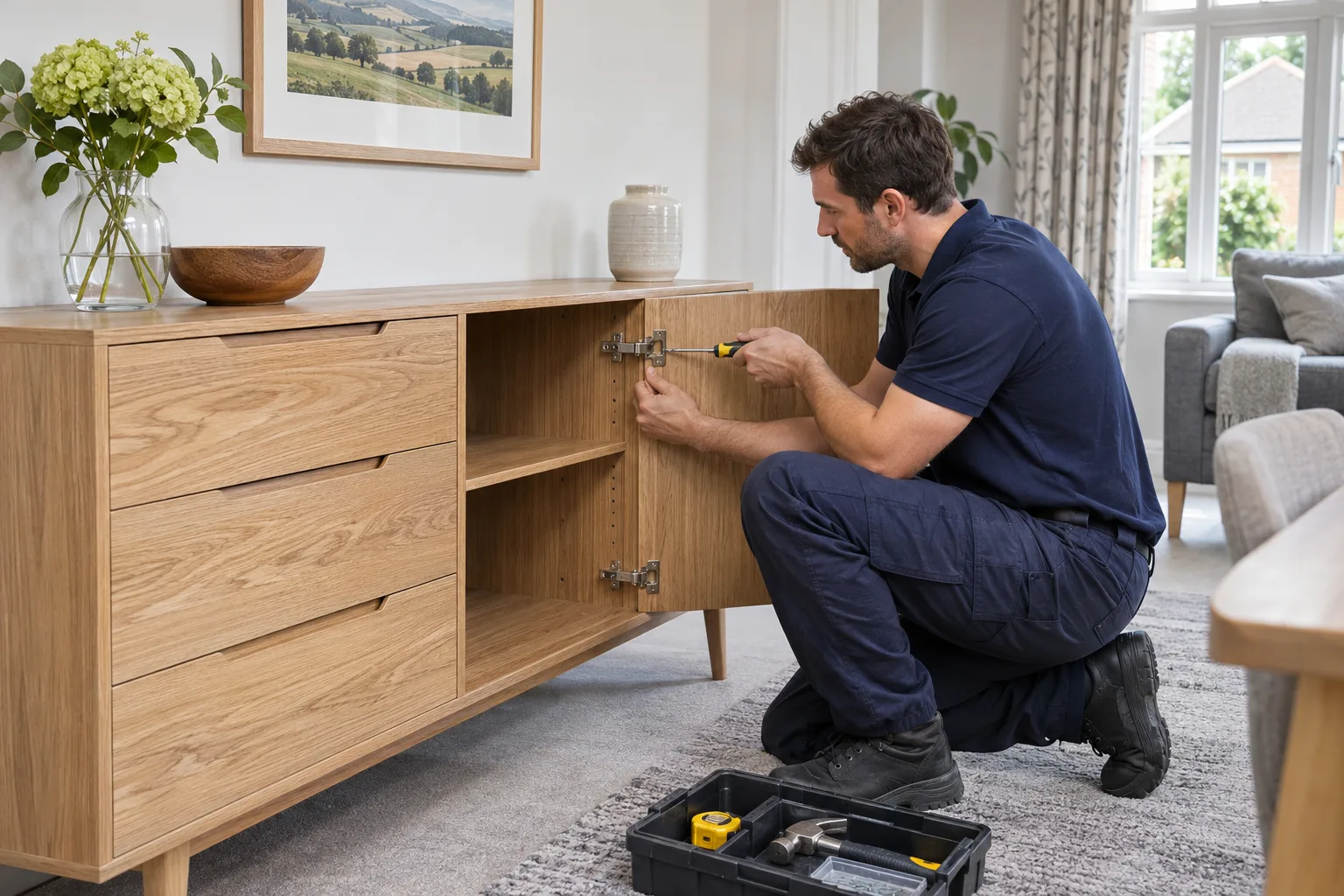
A chest of drawers takes up more room in use than it does when closed. Its top may fit neatly beneath a window, but the lowest drawer can meet a bed frame or the bedroom door. The unit also needs to stand as the manufacturer intends, with any specified wall restraint fitted to a suitable fixing point. Decide on its position before assembly by checking the full drawer path, floor condition and access around the furniture, not only the width of the empty wall.
Find the exact model drawing and record its width, depth and height. Check whether handles project beyond the stated depth and whether the drawers are full-extension. A product photo rarely shows the drawer fully open, so use the manual or ask the supplier for the extension measurement if it is missing. Mark the unit’s closed footprint on the floor with low-tack tape, then mark the farthest point each drawer reaches. Allow standing room beyond that line; the user must be able to pull a drawer and see or lift its contents.
Test the drawer path at several heights
Open the bedroom door, wardrobe door and nearby drawers in the intended arrangement. Their movements may conflict at different heights. A chest can clear a bedside cabinet when its top drawer opens yet strike the bed with a wide bottom drawer. Check radiator valves, window boards and wall-mounted shelves too. The drawer front may hit an obstruction above floor level that is invisible in a tape outline.
If the room has a sloping ceiling, check the clearance above the chest before deciding to build it in place. A tall unit may fit when standing near the centre of the room but be impossible to rotate upright against the chosen wall. Measure the diagonal of the assembled carcase or follow the maker’s stated assembly method. A lower chest, another wall position or assembly in its final orientation may be needed, depending on the instructions.
Test access in everyday use
If a chest will stand beside the bed, consider how the room is used at night. Can a person still walk to the door when a drawer is left partly open? Is there room to kneel or bend to reach its back? A narrow passage that works in an empty room may be impractical once bedding, a chair and a laundry basket return. Measure the route from both sides of the bed rather than relying on a single distance from the chest to a wall.
Do not assume that every drawer has the same travel. A tall chest may mix shallow upper drawers with deep lower drawers, or the runners may extend differently. If the maker supplies a stop or soft-close mechanism, the final reach depends on it being assembled correctly. Identify the correct handed runners and mounting holes before the unit is put into use.
Check the floor and the wall behind it
A chest should stand on a stable floor in the way its instructions specify. An uneven floor can make the cabinet appear twisted, with drawer gaps that narrow at one side. If levelling feet are supplied, use their permitted range. Avoid sliding random packing pieces under one corner or pulling the cabinet square with a wall fixing. The wall restraint is not a substitute for assembling and supporting the unit properly.
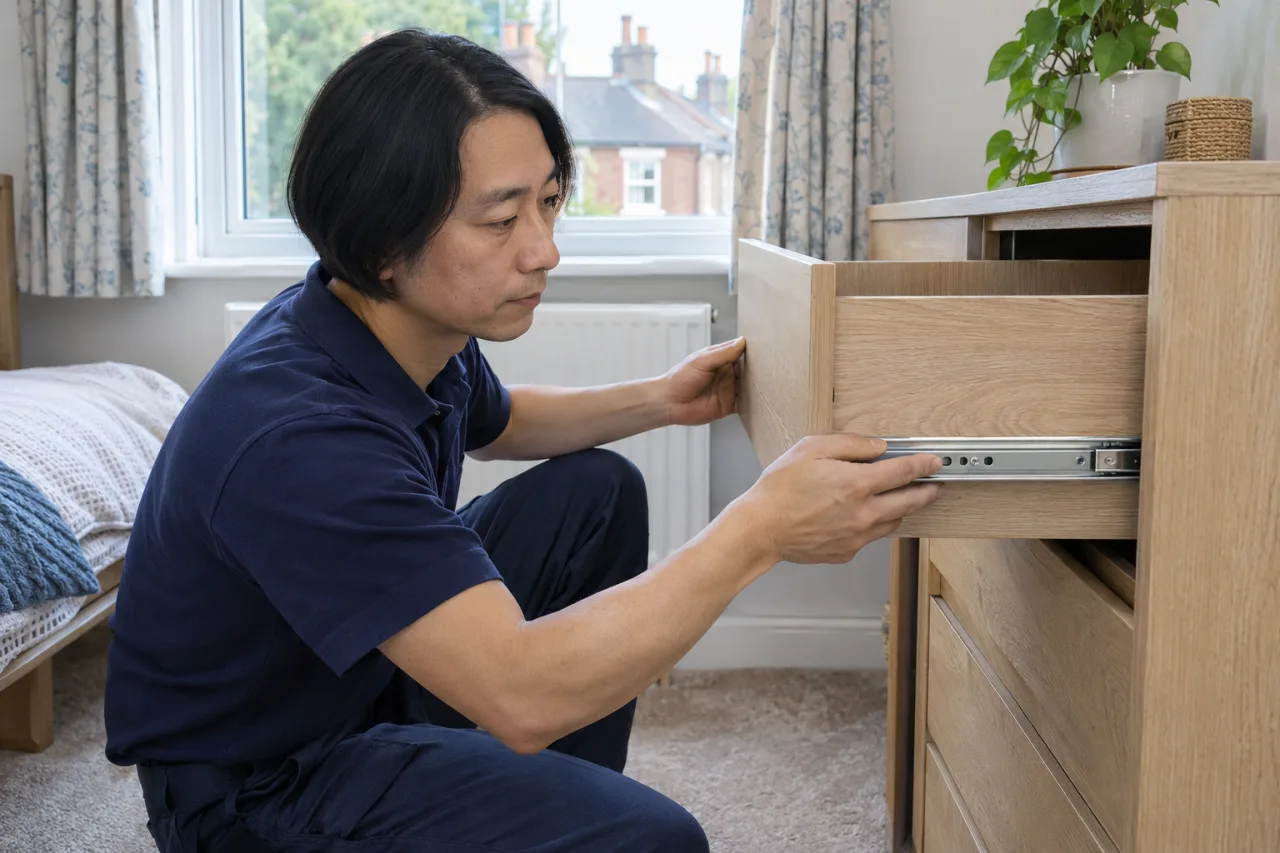
Check whether carpet pile, a rug edge or a floor threshold changes the stance. A tall, narrow unit may rock on a thick rug even when all feet contact the floor. Moving it a few centimetres may solve the problem, provided the drawer path still works. Inspect the skirting board: a deep profile can hold the back away from the wall. The manufacturer’s restraint bracket may need a specific spacer or position; use the method it specifies rather than forcing the cabinet flush.
Identify the wall construction before planning any required restraint. Painted plasterboard, masonry and a lined wall can look the same from the room. The fixing method must suit the actual wall and the manufacturer’s instructions. Check for sockets, pipes and other hidden services in the fixing area. In a rented property, resolve permission for drilling before scheduling work. If the maker says the chest must be restrained, do not treat that instruction as optional because the unit feels heavy when empty.
Think about loading and access
The room position should let heavy or frequently used items sit in drawers that are easy to reach without awkward twisting. Follow the manufacturer’s load limits and any guidance about distributing weight. A top-heavy arrangement can affect stability, especially when several drawers are open. Keep the drawers closed when not in use and follow the maker’s warnings about children climbing on furniture. Do not place a television or another heavy object on top without checking the top’s permitted loading and the restraint requirements.
Consider access to cleaning and maintenance. A chest pressed against a radiator can block heat and make a valve unreachable. A unit covering a socket can encourage cables to be pinched behind it. Measure the protrusion of plugs and decide whether the socket must remain accessible. If the chest sits beneath a window, check that blinds or curtains do not catch on the top and that the window can still be operated safely.
In a narrow hall or landing, a chest may look like useful storage but reduce the route needed for furniture deliveries or everyday movement. Open its largest drawer while carrying a folded laundry basket to test the practical passage. If the chest must be moved to open fully, choose another position or a different unit. Repeatedly dragging an assembled chipboard cabinet can loosen joints and damage the floor.
Plan assembly around the final location
The cabinet may have to be built near its final position because it is too large to turn through the doorway once assembled. Measure the longest panel and the available floor area to lay it flat. Protect the floor with a clean, level covering that will not bunch under the cabinet. Keep drawer components grouped by size and position, since similarly shaped fronts and runners can belong to different levels. The flat pack assembly service can be planned with the exact model, intended wall and room photographs.
Read whether the maker requires the back panel to be fitted before the drawers. A cabinet that is not square can make correctly fitted drawers bind. Do not tighten or force drawer slides to compensate for a racked frame. Follow the model’s sequence, check diagonal alignment where the instructions allow, and then insert one drawer at a time. Keep children away from a partly assembled cabinet that has not yet been restrained as directed.
When the unit is built, test each drawer empty, then in the room’s normal arrangement. Confirm it opens and closes without scraping, that the front gaps are even and that the cabinet remains steady. If a drawer catches, inspect its runner and the cabinet alignment before loading it. Do not pull harder against a stop. Recheck the wall restraint after moving the chest or changing the room layout.
A useful assembly enquiry includes the model code, overall dimensions, drawer extension, intended room location, floor type and the wall where any required restraint would attach. Add photographs with the bedroom door and nearby furniture visible. Those details make it possible to spot an access or fixing problem before the chest is built in the one place where it cannot work.