

FURNITURE & MOVING / FROM THE BLOG
What to Check Before Assembling a Storage Bed

A storage bed adds moving parts to a piece of furniture that also has to support a mattress and its users. The frame may fit the bedroom while its drawers cannot open beside a wall, or a lift-up base may meet a low windowsill when raised. Before assembling one, check the exact model’s dimensions, the operating direction and the space needed around it. The goal is to establish a position where the storage can be used as intended, not merely where the bed can be squeezed in.
Read the manufacturer’s instructions for the specific size and version. A standard double and a king size bed in the same range may have different centre supports, gas struts, drawer arrangements or lifting directions. Compare the package labels with the order and check that all structural pieces and mechanism components are present. Keep the mattress specification to hand too: some lift mechanisms are designed for a particular mattress weight range.
Measure the bed in its working position
Mark the outside length and width of the assembled frame on the floor. Include the headboard, footboard, side panels and any projecting handles. Measure from the wall to the front edge of nearby furniture at several points. A radiator or a bedside chest can intrude into the path of a drawer even though the mattress footprint looks clear on a plan.
Keep a route around the finished bed
Check the room door and the route around the bed. An assembled bed can leave a passage that is just wide enough to walk through, but still too narrow for lifting a mattress, accessing a drawer or cleaning beneath an edge. If the frame must be assembled away from the wall and moved into place, confirm that there is room to make that move without twisting it or catching the headboard on a socket or window sill.
Measure ceiling height and anything above the bed when considering a lift-up model. A sloping ceiling, low pendant or shelf can be hit by the raised mattress and base. The open angle shown in a product picture is not a reliable measurement. Look for the manufacturer’s opening-height drawing or ask for the exact figure, then check it against the obstruction at the proposed bed position.
For drawer beds, measure the full pull-out path
Each drawer needs room to travel from closed to fully open, including its front and handle. Mark that travel on the floor with tape. A bedside table may block the first part of the movement; a wardrobe door might conflict only near full extension. Check both sides if drawers are fitted on both sides. A side against the wall may render one drawer useless unless the model permits a different arrangement.
Look at the handing of the drawers. Some beds allow the drawer units to be assembled on either side; others have fixed panel holes and runner positions. Do not assume you can reverse a drawer after the frame is complete. Confirm the permitted arrangement in the instructions before tightening the main frame or fitting the runners.
The drawer may also need vertical clearance. A thick rug with a raised edge or an uneven floor can catch a low front, while a nearby radiator pipe may obstruct the bottom of the drawer at full extension. Check the floor surface where the drawer will move. If it catches after assembly, inspect the runners, frame squareness and floor condition before forcing it or adjusting fittings outside the manufacturer’s method.
For lift-up beds, check direction and handling
An ottoman-style bed may open from the foot or from one side. That choice changes where a person stands and what needs to be clear. A foot-opening base may be awkward against a wall at the foot of the bed; a side-opening version may be unusable beside a wardrobe. Draw the lift direction on the room plan and identify where hands and feet will be during operation.
Gas struts and hinges are supplied as matched components. Check their labels and mounting positions against the manual. Never substitute a visually similar strut or change the fixing position to alter the opening force. The weight of the base and mattress must be within the manufacturer’s stated range. If the mattress has not yet arrived, check whether the mechanism is meant to be tested without it; some systems behave differently when unloaded.
Follow all instructions about temporary supports, two-person lifting and the sequence for attaching the mechanism. An unsupported raised base can fall suddenly. Keep children, pets and loose objects clear during the build and any initial test. If a component is missing or damaged, leave the mechanism unoperated until the correct part is obtained. The storage space is not ready for use merely because the frame stands upright.
Check the frame and central supports
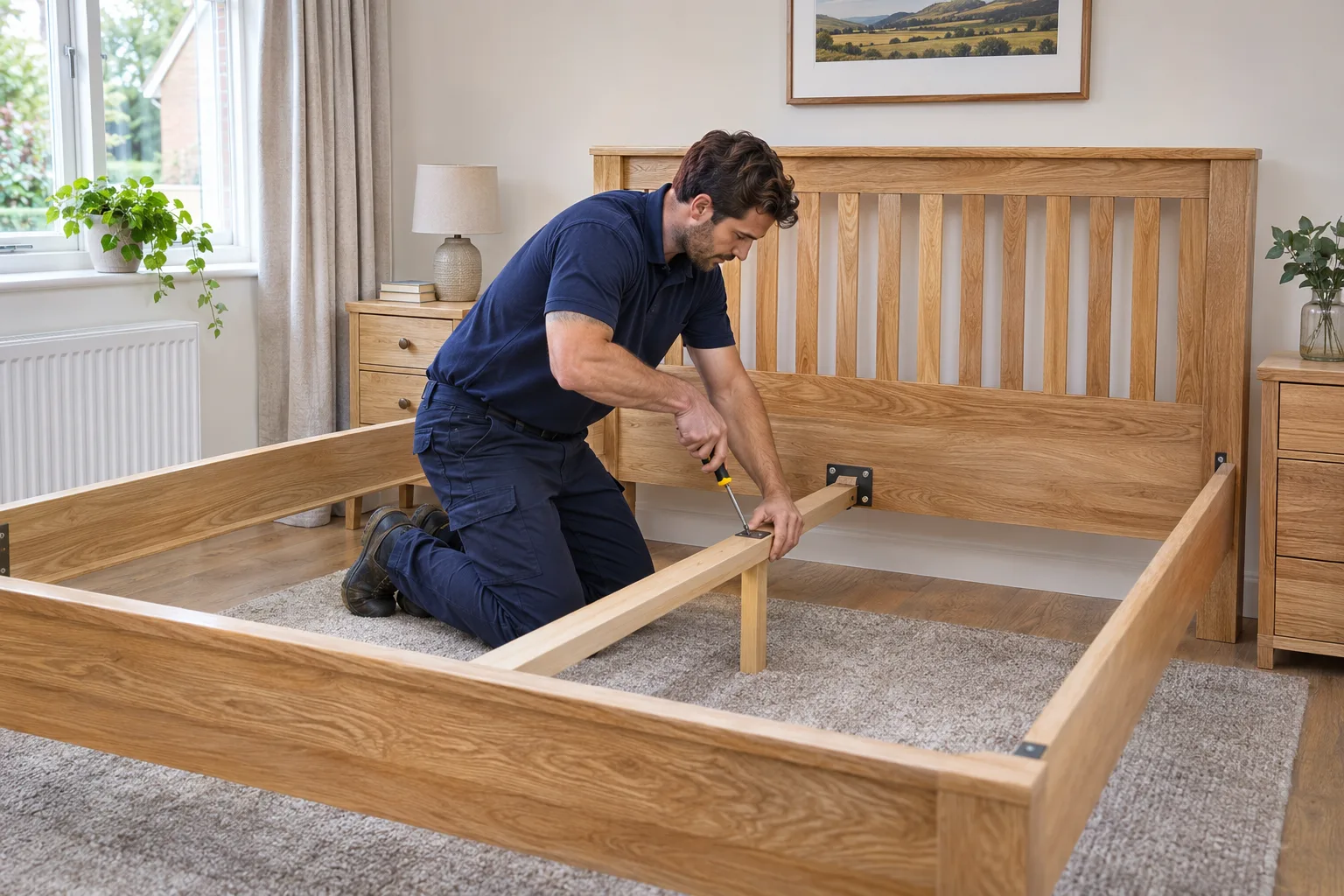
Storage beds often rely on centre rails, legs or panels beneath the mattress platform. Identify each support in the parts list and locate its intended position. The bed may look complete from the outside while a centre foot is still unadjusted or floating above the floor. Check that supports make the floor contact specified by the manufacturer and that the platform is seated correctly.
An uneven floor can affect the frame and drawer operation. Do not use random packing pieces under individual legs unless the manufacturer approves that approach. Follow the model’s levelling instructions, then check that the frame remains square before fitting drawers or the lift base. If the support arrangement is unclear, consult the manual for that exact size rather than copying a photograph of another bed.
Before putting the mattress on, inspect slats or platform panels for the correct orientation and spacing. Some slats are curved and have a specified way up. Others are held by end caps or a central connector. A separate final check of the slats and centre supports is useful, but the manufacturer’s own directions remain the authority for the particular bed.
Keep the assembly area clear
A bed frame takes up much of a small room before it is finished. Reserve a protected area for long side rails, the headboard and any preassembled drawer boxes. A lift base may be a large rigid panel that cannot be turned easily between walls. Check the route from the delivery point to the bedroom for the longest package, especially around stairs and narrow landings.
Sort fixings by assembly stage. Runners, hinges and centre supports can use screws of different lengths; mixing them can damage finished surfaces or weaken a joint. Keep the instructions visible and open only the packs needed for the current stage. A clean floor covering protects panels, but it should remain flat beneath the frame so the structure is not twisted during assembly.
If other furniture remains in the room, work out what can move temporarily and where it will go. Moving a chest into the doorway may create floor space while blocking the path for the lift base. The flat pack assembly service can be planned with the exact bed model, package sizes and room photographs so the working area is understood before a visit.
Test storage and access before normal use
Once the frame is complete and the mattress is fitted as specified, operate every drawer or lifting mechanism through its full intended movement. Listen and feel for rubbing, check that catches engage and confirm that the raised base stays in the position described by the manufacturer. Do not store heavy objects until the mechanism and supports have been checked and any load guidance understood.
Open the storage with the room in its everyday arrangement. Put the bedside table back, open the wardrobe door and walk the usual route around the bed. This reveals conflicts that a test in an empty room can miss. If a drawer cannot fully extend or a lift base meets an obstruction, change the room position or use a manufacturer-approved configuration rather than accepting a partially working installation.
The useful pre-assembly information is straightforward: exact product code, bed and mattress sizes, storage type and opening direction, room dimensions, nearby obstructions and the delivery route. With those details, the build can be assessed against the actual bedroom and the manufacturer’s sequence. A storage bed works well when its frame is correctly supported and its storage remains genuinely accessible after the room is put back together.